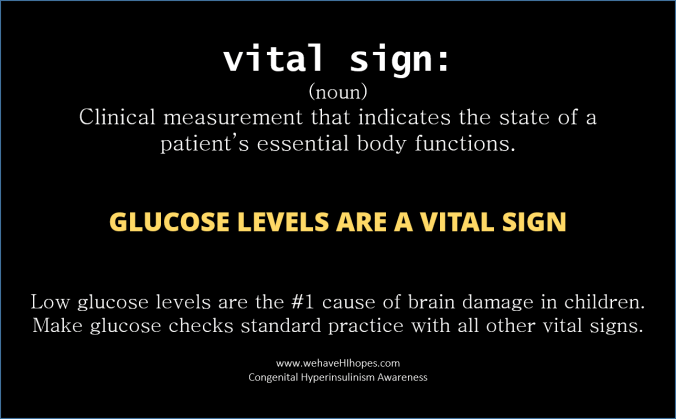
Glucose Levels are Vital Signs
There are days when I could cry if one more person says, “Oh, he looks great! He must be doing well!” Of course, I know it’s well-meaning. But when you’re in the trenches of a struggle and people congratulate you on a success that isn’t real, it’s disheartening.
When your child has invisible conditions, it’s hard for others to look at a beautiful toddler and see that his life is in jeopardy every moment of the day. Some days, I just smile and nod because explaining it all would take more time than either of us has. And I am grateful that people care enough to ask how he’s doing. But the misconception that looking “okay” means being okay isn’t true.
What’s even harder? When I’m the mom, looking at my seemingly healthy child, searching for the one tiny sign that something is wrong. That one subtle clue that others would overlook—because if I miss it, it could mean another emergency. Even his dad will admit that sometimes, he thinks our son is fine, but I see something—a barely perceptible difference. And sure enough, we end up earning more frequent flyer miles at the children’s hospital.
My rare superhero is my second child. My first was a breeze—truly. I remember lying next to her, soaking in every little detail of her face, her laugh, her smell, those sweet baby kisses. Motherhood with my son started the same way—until one day, everything changed.
Now, I still try to enjoy all those little moments, but my eyes have become like an X-ray machine, constantly scanning him for signs of distress. His rare conditions have robbed me of that blissful ignorance.
When my gut first told me something was wrong, we rushed him to the ER. I tried to explain to the doctor that something was off. His personality was gone. He wasn’t blinking. He was staring into space. The doctor took one look at him—without running a single test—and sent us home.
“He looks fine.”
“He’s perfectly healthy.”
“Go home and enjoy him.”
He blamed it on new mom paranoia. And for a moment, I questioned myself.
Those doubts didn’t last long—because when a mother’s gut says something is wrong, there’s no stopping her.
A few days later, I took him to another ER. Within 30 minutes of arriving, everyone knew something was dangerously wrong. My son was near death from severe hypoglycemia. Yet, on the outside, he looked normal.
He is hypoglycemia unaware—his body doesn’t show typical signs of low blood sugar. And his disease? Congenital Hyperinsulinism—the #1 cause of irreversible brain damage in infants. No pressure, right?
As if that wasn’t enough, he was also born with two rare congenital birth defects in his larynx, masked by silent aspiration.
I had never even heard of silent aspiration before. It means that when he inhales liquids or solids into his lungs, there’s no coughing, no watery eyes—no outward sign at all. By the time we figured it out, he had already suffered permanent lung damage.
Now, after years of misdiagnoses and setbacks, we are finally, hopefully, on the road to recovery.
Having a child with invisible conditions has made me question my own sanity. I wonder how people see me.
I don’t know.
If you need perspective, imagine your dream home.
The one you’ve daydreamed about—the one you’d buy with your lottery winnings. It’s stunning. Incredible curb appeal. A white picket fence. A wrap-around porch. Room for the tallest Christmas tree. Spiral staircases. Every feature you’ve ever wanted.
Inside? It holds everything that means something to you.
But there’s one catch.
It’s built on a sinkhole.
At any moment, it could all collapse.
That’s what an invisible disease feels like—for me, anyway.
Or maybe a better analogy:
Imagine you have a beautiful, intelligent, loving little boy. He completes your family. He makes your life whole. He has a wonderful life ahead of him—one he has had to fight for, every single day.
Inside him are diseases and conditions most people have never heard of. And you? You have to be on guard every moment of every day to get him to the next. You have to see what others can’t. Complacency is never an option.
Most moms in my shoes will tell you—we’re grateful for what we have. And we truly are.
I love my children. As perfectly imperfect as we all are, this is the journey we’ve been given. And we have an incredible support system—I will forever be grateful for the kindness we’ve been shown.
But this road is hard.
Because what you see isn’t always the truth.
For my family, rare is our reality. And from the outside? It looks really pretty.
On the inside?
Well… that depends on the day.
Update on our little superhero:
We’ve recently had to increase Jackson’s diazoxide dose to the highest level since his diagnosis—12.3mg/kg. For almost two weeks, he has been more unstable than he has been since his discharge in September. Oddly, this instability is only happening in the mornings and early afternoons.
Some days, his blood sugar drops into the 40s, but mostly, he’s in the low 50s/60s. The 60s aren’t too concerning on their own, but the 40s and low 50s—especially when they occur within 45 minutes of eating—are a clear sign that something has changed.
We don’t know why the sudden shift.
If his medication reaches 15mg/kg, we will have no choice but to explore other forms of treatment, which include:
We hope it doesn’t come to that—that would be the last thing we want. But if this pattern continues, we may have no choice.
Before making any decisions, Dr. Paul wants Jackson admitted back to Texas Children’s Hospital for closer observation, additional labs, and a controlled diet to test different meal types. If things don’t improve over the weekend, I suspect he will be readmitted next week.
Despite everything, this kid is a trooper. You’d never know by looking at him that he’s so sick—which is terrifying for those watching over him, but I’m grateful that, at such a young age, he still enjoys life so much.
On Wednesday, we had our genetics appointment with Dr. Craigen. There is one more test to run—Global MAPS—which will look for biochemical abnormalities in his plasma.
If that test is inconclusive, our final step in the genetic discovery process will be applying to the Undiagnosed Disease Network (UDN). There’s no guarantee we’ll be accepted, but we have a passionate endocrinologist with a strong genetics background advocating for Jackson.
Dr. Nadia Merchant will present his case to the board, pushing not only for him, but for all undiagnosed genetics cases suffering from Hyperinsulinism. I truly believe she wants this as much as we do.
One huge bonus—Baylor College of Medicine is one of only two sequencing cores for the program, meaning there will be no travel expenses for us to participate.
Please pray that Jackson’s case gets approved.
It may not change his prognosis, but it could lead to significant advancements in the Hyperinsulinism world.
We really want this.
From a fellow blogger and friend, Dani.
I love quotes. There are so many really good, meaningful quotes about the importance of community. “It takes a village to raise a child.” “We rise by lifting others.””Alone we can do so little; together we can do so much.” “Your vibe attracts your tribe.” Community is not just important, but valuable to the human experience. If I believe one thing only about people, it is that we are powerful when we come together for a common cause. You can see it in volunteerism, in disaster recovery… or in my case, in making life a little easier for a mama with her baby in the hospital.
I’m a part of this amazing community. Most of us have never met each other. We have every spectrum of income, education, politics, and religion. Just about every style of parenting, relationship, career and lifestyle can be found in our group. We are all…
View original post 904 more words

 We have HI hopes