Sugar Bugs

Lancets and Test Strips

They say a picture is worth a thousand words, but looking at this picture, I could tell you thousands.

These lancets and test strips are from our sharps container at home—all from glucose checks—and this isn’t even half of what we’ve used over the last few months.

To me, these are:

  • Hundreds of pokes on the sweetest baby toes you’ve ever seen.
  • Scared moments when his sugar dropped too low.
  • Late nights and early mornings, woken by his crying.
  • CGM calibrations, testing how new foods affected his sugar.
  • Moments of panic when he was throwing up, and we didn’t know how long we had before he’d become hypo—when we were checking every 30 minutes or less, all while rushing through Houston traffic to the Texas Medical Center.

But mostly—thankfully—these were our reassurance that he was okay.

This is what our lives have revolved around for the last nine months.


Checking for “Sugar Bugs”

Somewhere along the way, we started calling it “checking for Sugar Bugs.”

No idea why—one of us said it, and it stuck.

“How many Sugar Bugs are we going to find? Let’s catch lots and lots of them! Yay! We found 92!”

Seems a little silly, but we’re trying to make it fun, to make it positive.

He doesn’t cry anymore when the lancet pierces his skin.
He doesn’t wake up when we poke him at night.
His big toes are so callused now that sometimes, getting a single drop of blood is a challenge.

I remember when we first started this journey—his tiny toes red with bruises, worn from too many pokes.wehavehihopes toes


A Cure Fast & A Mother’s Hope

Now, here we are—just days away from the start of our Cure Fast at Texas Children’s.

I am so anxious.

We’ve slowly reduced his Diazoxide intake from 9.54mg/kg to 8.18mg/kg.

So far, he’s doing really well. A few numbers near 70, but for the most part, he’s hanging around 120.

I pray that’s a good sign.

I’m scared to be disappointed because no matter how many times I tell myself “Don’t get your hopes up”—they’re up.

After all, I’m a mom with HI Hopes.

It’s who I am.

I want this so badly for him.
For us.

The next two weeks will be a rollercoaster of emotions, but I want to know.
It’s the not knowing that makes me feel crazy.

If he has to live with HI longer—or even for the rest of his life—we’re going to manage.
I know that.

But I pray he doesn’t have to.


Dreaming of a Life Without HI

One day, I hope that when I look at that pile of lancets and test strips, the words that come to mind are in past tense.

That they become things we used to have to do.

That they turn into distant memories, replaced by new ones in a life free of Hyperinsulinism.

How sweet that life could be.

I don’t know if that’s what’s in store for us.

But I’m holding that dream close to my heart—and never letting go.
Safety Fast for Hyperinsulinism

wehavehihopes cgm low.png

Safety Fast for Hyperinsulinism

We arrived at Texas Children’s Hospital on Sunday at 7 PM for Jackson’s first Safety Fast since his discharge in September. We knew it would be tough and prepared as best we could. We didn’t think he would last longer than eight hours, but we needed to know.

Some parents of HI kids choose to skip the fast, and I understand why—withholding food to force a hypoglycemic state sounds barbaric. But we felt it was necessary to ensure his diazoxide dose was high enough to sustain him and to check for any changes in his lab results.

The fast began at 8:30 PM. He stayed on schedule with his diazoxide and was allowed water. His starting blood sugar was 81. We checked every three hours until he dropped below 70, then every hour until 55. Our goal was to see how low he would go before showing symptoms, then administer glucagon, complete a glucagon challenge, and run labs.

The Results: A Shock to Everyone

Jackson’s blood sugar remained above 70 for 10 hours—far longer than expected. But when it dropped, it plummeted—going from 70 to below 50 in just two hours. He hovered between 44–32 for hours.

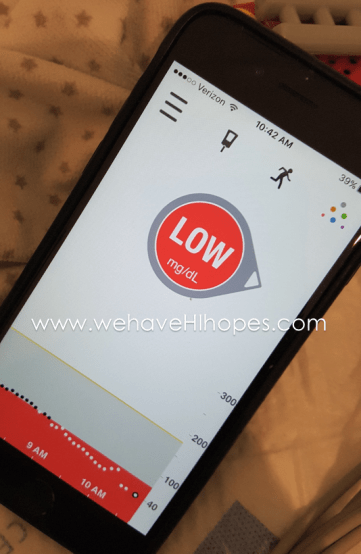
He never showed typical signs of hypoglycemia—no sweating, clamminess, or shaking. Since he can’t communicate, we don’t know what he felt, but he was cranky, asking for milk, and visibly miserable. His CGM alarm kept going off, and we learned that when blood sugar drops below 40, the app stops showing numbers and just reads LOW.

After three hours, his face lost color, and we stopped the fast, took labs, and administered glucagon. Despite everything, he remained alert, playing and even laughing between crying. At that point, he had fasted for 15 hours.

Unexpected Findings

In past glucagon challenges, Jackson’s blood sugar always rose as expected. Not this time.

  • Starting glucose: 34
  • 15 minutes: 44
  • 30 minutes: 38
  • 60 minutes: 32

Instead of rising, his glucose dropped. He was immediately given D10 (dextrose) through his IV and allowed to eat. His sugar quickly spiked to 210, and after stopping the dextrose, he stabilized between 85–120.

Then came the biggest shock—when Dr. Paul reviewed the results, he said something we never expected to hear:

Jackson was making ketones.

For the first time.

HI kids don’t make ketones—that’s part of the disease. But Jackson did.

Even more surprising, the glucagon response showed that his liver was distributing glycogen appropriately—meaning the glucagon “failure” wasn’t due to a liver issue.

These results suggest that Jackson may have Transient Hyperinsulinism—something we never thought possible at this point.

Most cases of transient HI resolve within the first 30 days of life—some within the first year. Jackson was diagnosed at four months old and just celebrated his first birthday, so the odds were not in our favor.

But now?

Dr. Paul believes there’s reason to have HI HOPES.

Testing the Theory: Three Options

  1. Let him outgrow his dose until he’s below 4mg/kg
  2. Slowly wean him down
  3. Admit him for a Cure Fast

We’ve chosen to admit him. It’s not that we can’t do this at home, but we want the added security of a team who knows this disease inside and out. If something happens, we want an army behind us.

So in two weeks, we’re going back.

A Mother’s Reality Check

Yesterday, Dr. Paul looked at me and said, “You know, if he outgrows this, you’re going to go through withdrawals.”

He might be right.

Since August, my brain has been running 100 mph—researching, advocating, managing appointments, fighting insurance companies, running a Facebook page, a website, planning a fundraiser, constantly checking my phone for his CGM readings.

If he no longer has HI, we’ll suddenly be thrown into “normal” life—something I’ve never considered a possibility.

But I’d much rather have a calm life with a healthy kid than a hectic one with a sick kid.

None of this is guaranteed. But there’s hope.

This morning, I let Jackson sleep in before daycare. Yesterday was rough on him, and he needed the rest. When I walked into his room, he jumped up to greet me—and I was overcome with emotion.

No matter what the Cure Fast shows next week, I will never stop fighting for him.

This kid is amazing.
He is strong.
He is a fighter.

He is sunshine and rainbows in every storm we go through.

And he deserves a life free of illness.

I want this for him so badly.

#wehaveHIhopes

Dr. Jason Goldberg, UTMB – A True HI Achiever

Dr. Goldberg was thrown into the HI world by chance, a perfect storm that brought him and Jackson together. Maybe it was divine intervention.

As many know, Texas Children’s Hospital has been instrumental in diagnosing and treating Jackson’s Hyperinsulinism, but our journey started before we ever landed on their doorstep. It began in Dr. Goldberg’s office… with me, scared and desperate for help.

I had no idea that the new doctor we had to see by default would become the one to help save Jackson’s life.


Dismissed at the ER, Searching for Answers

When Jackson had his first seizure and started acting abnormally, we went to our local ER. The attending dismissed us.

I now know this happens all the time with HI kids. No one looks at a baby and thinks, “I wonder if they are hypoglycemic?”

This doctor made me question myself. He laughed off our concerns and said, “Babies do this all the time when they’re teething. It’s completely normal.” He told us that since we had such a large age gap between kids, it was understandable that we’d overreact.

I regret taking his words to heart.

Because Jackson continued to suffer. His brain continued to suffer.

I became too unsure of myself to seek an immediate second opinion. But after three more days of Jackson’s temperature running cold, zoning out, losing energy, and not crying for food, I couldn’t wait any longer.

Enough was enough.


Meeting Dr. Goldberg

I called our pediatrician’s office for a same-day appointment. She was out. The only option? Dr. Jason Goldberg at UTMB.

I’ll be honest, I was a little disappointed to see someone new. I wasn’t in the mood to deal with an unfamiliar doctor. But I trusted the office, so we took what we could get.

On the drive there, I knew I wasn’t leaving without answers. I couldn’t have another doctor dismiss me. I needed someone to listen.

Dr. Goldberg walked into the exam room and introduced himself.

Before he could say another word, I pounced… looked him dead in the eyes, more desperate than I had ever been, and said:

“Something is wrong with my son. Don’t tell me I’m overreacting. I have common sense, and I am not going to be dismissed. My son needs help.”

I was straightforward and maybe even a little rude.

But he didn’t flinch.

“Okay,” he said. “You know him better than anyone. If you tell me something’s wrong, then something must be wrong. Start from the beginning.”

So I did.

I could see it in his eyes, he knew something wasn’t right. He suspected neurological issues.

Then, he said the words that changed everything:

“Get in your car and head straight to Texas Children’s.”

“If they won’t see him, call me. If I have to keep this office open late and bring in a specialist, I will. Whatever we have to do, we’ll do it. We’ll figure this out.”

I took Jackson and drove straight to TCH.

You know the rest of the story.

When we arrived, Jackson’s blood sugar was 21 and likely moments away from brain damage or worse.

We arrived just in time.


More Than Just a Doctor

Dr. Goldberg continued to follow Jackson’s case through UTMB’s shared system with Texas Children’s.

During our initial three-week stay, he even called us personally just to check in. Not because he had to, but because he cared.

When we were ready for discharge, TCH recommended switching Jackson’s primary care to their system for easier coordination. It made sense.

But we weren’t going anywhere.

Dr. Goldberg helped save Jackson’s life. We were staying with UTMB. We were staying with him.


A Rare Doctor for a Rare Kid

Since then, Dr. Goldberg has:

  • Researched Hyperinsulinism and Diazoxide to prepare for Jackson’s care.
  • Seamlessly coordinated between UTMB and TCH to ensure the best treatment.
  • Never rushed us, no matter how busy he was.
  • Always looked at the whole picture, asking questions and researching every possibility.
  • Truly cared—about Jackson, about our family, about this journey.

There aren’t many doctors like him.

We could never repay him for what he’s done… for keeping Jackson safe and healthy, or for the sanity he’s given me on the hard days.

Days when I’ve shown up at his office stressed, scared, tired, overwhelmed, or even in tears.

Dr. Goldberg is who you want in charge of your child’s health.

My rare kid has a rare doctor.

We’re pretty lucky.

Dr. David Paul, Endocrinologist, TCH

Dr. David Paul: My Next HI Achiever.Hyperinsulinism Dr Paul TCH

Dr. Paul was Jackson’s endocrinologist at Texas Children’s Hospital (TCH). We met him on day three of our initial hospital stay, and he was with us for the long haul for many hospitalizations after.

I still remember the first time he walked into the PCU room. He took the lead in the conversation, and I stopped him.

“What is your name, and what is your role?”

Everything was a whirlwind… doctors and nurses coming and going like a revolving door. Everything was running together, and I couldn’t make sense of all the possibilities. But by that morning, I was ready.

I had a pen and paper in my hands, writing down everything he said. I wanted to know it all.

So many things were new.
So many things were unknown.
I was overwhelmed.
I was scared.

My son was sick, and I didn’t know why.

Initially, I refused to Google anything. Told family and friends that if they did internet searches, to please keep us out of the loop. I couldn’t go down a rabbit hole. I needed facts.

Dr. Paul was my main source of information.
He was going to figure this out, and I trusted that.

The Whiteboard Wall & A Doctor Who Listens

By the second morning, when Dr. Paul did rounds, this is what he walked into (see photo below).

Hyperinsulinism Dr Paul TCH 2

I realized the hospital room wall could act as a whiteboard. Our PCU nurse, Renee, gave me a marker, and I went all in.

You can’t see the other five feet of notes to the left of the picture. I needed to visualize it all, to make sense of everything.

Some doctors walked in and chuckled, joking that I looked like I was cramming for an exam.
Some were impressed.
Some didn’t even notice.

Dr. Paul?

He saw my notes and went through them, line by line.
Every. Single. Day.

He never rushed me.

There were times he’d stop by after his rounds, sometimes for an extra hour or more—just to answer my questions. We discussed research papers, case studies, and random thoughts I had in the middle of the night.

A doctor who doesn’t rush you?
A doctor who cares about what you think?
A doctor who engages a mother’s “Google doctorate”? (Yes, eventually, I gave in and started doing online searches).

He’s one of a kind.


An Unsung Hero in the HI World

I liked Dr. Paul right off the bat.

You can see the wheels turning when he’s faced with a complex issue. There’s no mistaking his candor or his intelligence.

Naturally, I searched for information about him online, expecting to find his name all over the Hyperinsulinism world, but my search came up empty.

Not that I need a doctor to have a shelf full of awards to be “experienced” enough to treat my kid, but I was surprised he wasn’t more widely recognized.

Dr. Paul has been treating HI since the 90s.
He has seen and treated more HI kids than most endocrinologists will in their entire careers.

So, while you won’t see his name in big fancy lights, he’s an unsung hero in the HI world.
And in our world, he’s a legend.


Beyond the Hospital Walls

Since our initial hospital stay, Dr. Paul has continued to be an incredible doctor.

✅ He’s visited Jackson during hospitalizations that weren’t even endo-related.
✅ He’s humored me by answering far too many emails and random questions.
✅ He’s introduced us to other amazing doctors.
✅ He’s advocated for us when Jackson was ambulanced to a hospital that was scared to treat him because they had never had an HI patient before.
✅ He’s answered texts on weekends when I was terrified.

Far more than any doctor in any other capacity would have ever done.


A Steady Anchor in the Storm

I truly can’t imagine going through this journey with another doctor.

And trust me, we’ve met a lot of them.
Even other experts.

They were all great, fantastic, even.
But they’re not him.

Not only has he been amazing for Jackson, but he has pushed me to be a critical thinker. Honestly? He makes me wish I had pursued a career in medicine.

Since August 2016, our lives have been unpredictable.
It often feels like we’re caught in a tornado… twisting, turning, at an unpredictable pace.

And the one thing anchoring us down?
Him.

He keeps my fears in check because I know my son is in the best hands possible.
I can ask anything, no matter how silly it may seem to me, and he’s right there to answer.

Dr. Paul will do whatever it takes to keep Jackson safe and healthy.

And I trust him with Jackson’s life.

There’s no better feeling in the world than that.


#WeHaveHIHopes