Sugar Bugs

Lancets and Test Strips

They say a picture is worth a thousand words, but looking at this picture, I could tell you thousands.

These lancets and test strips are from our sharps container at home—all from glucose checks—and this isn’t even half of what we’ve used over the last few months.

To me, these are:

  • Hundreds of pokes on the sweetest baby toes you’ve ever seen.
  • Scared moments when his sugar dropped too low.
  • Late nights and early mornings, woken by his crying.
  • CGM calibrations, testing how new foods affected his sugar.
  • Moments of panic when he was throwing up, and we didn’t know how long we had before he’d become hypo—when we were checking every 30 minutes or less, all while rushing through Houston traffic to the Texas Medical Center.

But mostly—thankfully—these were our reassurance that he was okay.

This is what our lives have revolved around for the last nine months.


Checking for “Sugar Bugs”

Somewhere along the way, we started calling it “checking for Sugar Bugs.”

No idea why—one of us said it, and it stuck.

“How many Sugar Bugs are we going to find? Let’s catch lots and lots of them! Yay! We found 92!”

Seems a little silly, but we’re trying to make it fun, to make it positive.

He doesn’t cry anymore when the lancet pierces his skin.
He doesn’t wake up when we poke him at night.
His big toes are so callused now that sometimes, getting a single drop of blood is a challenge.

I remember when we first started this journey—his tiny toes red with bruises, worn from too many pokes.wehavehihopes toes


A Cure Fast & A Mother’s Hope

Now, here we are—just days away from the start of our Cure Fast at Texas Children’s.

I am so anxious.

We’ve slowly reduced his Diazoxide intake from 9.54mg/kg to 8.18mg/kg.

So far, he’s doing really well. A few numbers near 70, but for the most part, he’s hanging around 120.

I pray that’s a good sign.

I’m scared to be disappointed because no matter how many times I tell myself “Don’t get your hopes up”—they’re up.

After all, I’m a mom with HI Hopes.

It’s who I am.

I want this so badly for him.
For us.

The next two weeks will be a rollercoaster of emotions, but I want to know.
It’s the not knowing that makes me feel crazy.

If he has to live with HI longer—or even for the rest of his life—we’re going to manage.
I know that.

But I pray he doesn’t have to.


Dreaming of a Life Without HI

One day, I hope that when I look at that pile of lancets and test strips, the words that come to mind are in past tense.

That they become things we used to have to do.

That they turn into distant memories, replaced by new ones in a life free of Hyperinsulinism.

How sweet that life could be.

I don’t know if that’s what’s in store for us.

But I’m holding that dream close to my heart—and never letting go.
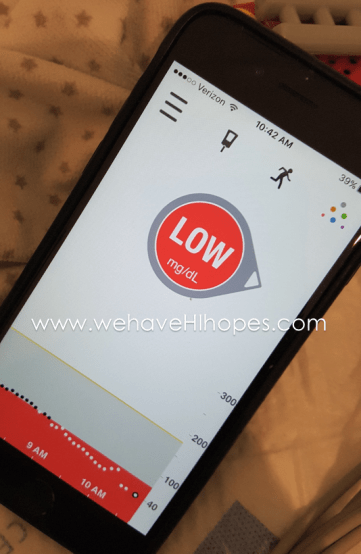
Safety Fast for Hyperinsulinism

wehavehihopes cgm low.png

Safety Fast for Hyperinsulinism

We arrived at Texas Children’s Hospital on Sunday at 7 PM for Jackson’s first Safety Fast since his discharge in September. We knew it would be tough and prepared as best we could. We didn’t think he would last longer than eight hours, but we needed to know.

Some parents of HI kids choose to skip the fast, and I understand why—withholding food to force a hypoglycemic state sounds barbaric. But we felt it was necessary to ensure his diazoxide dose was high enough to sustain him and to check for any changes in his lab results.

The fast began at 8:30 PM. He stayed on schedule with his diazoxide and was allowed water. His starting blood sugar was 81. We checked every three hours until he dropped below 70, then every hour until 55. Our goal was to see how low he would go before showing symptoms, then administer glucagon, complete a glucagon challenge, and run labs.

The Results: A Shock to Everyone

Jackson’s blood sugar remained above 70 for 10 hours—far longer than expected. But when it dropped, it plummeted—going from 70 to below 50 in just two hours. He hovered between 44–32 for hours.

He never showed typical signs of hypoglycemia—no sweating, clamminess, or shaking. Since he can’t communicate, we don’t know what he felt, but he was cranky, asking for milk, and visibly miserable. His CGM alarm kept going off, and we learned that when blood sugar drops below 40, the app stops showing numbers and just reads LOW.

After three hours, his face lost color, and we stopped the fast, took labs, and administered glucagon. Despite everything, he remained alert, playing and even laughing between crying. At that point, he had fasted for 15 hours.

Unexpected Findings

In past glucagon challenges, Jackson’s blood sugar always rose as expected. Not this time.

  • Starting glucose: 34
  • 15 minutes: 44
  • 30 minutes: 38
  • 60 minutes: 32

Instead of rising, his glucose dropped. He was immediately given D10 (dextrose) through his IV and allowed to eat. His sugar quickly spiked to 210, and after stopping the dextrose, he stabilized between 85–120.

Then came the biggest shock—when Dr. Paul reviewed the results, he said something we never expected to hear:

Jackson was making ketones.

For the first time.

HI kids don’t make ketones—that’s part of the disease. But Jackson did.

Even more surprising, the glucagon response showed that his liver was distributing glycogen appropriately—meaning the glucagon “failure” wasn’t due to a liver issue.

These results suggest that Jackson may have Transient Hyperinsulinism—something we never thought possible at this point.

Most cases of transient HI resolve within the first 30 days of life—some within the first year. Jackson was diagnosed at four months old and just celebrated his first birthday, so the odds were not in our favor.

But now?

Dr. Paul believes there’s reason to have HI HOPES.

Testing the Theory: Three Options

  1. Let him outgrow his dose until he’s below 4mg/kg
  2. Slowly wean him down
  3. Admit him for a Cure Fast

We’ve chosen to admit him. It’s not that we can’t do this at home, but we want the added security of a team who knows this disease inside and out. If something happens, we want an army behind us.

So in two weeks, we’re going back.

A Mother’s Reality Check

Yesterday, Dr. Paul looked at me and said, “You know, if he outgrows this, you’re going to go through withdrawals.”

He might be right.

Since August, my brain has been running 100 mph—researching, advocating, managing appointments, fighting insurance companies, running a Facebook page, a website, planning a fundraiser, constantly checking my phone for his CGM readings.

If he no longer has HI, we’ll suddenly be thrown into “normal” life—something I’ve never considered a possibility.

But I’d much rather have a calm life with a healthy kid than a hectic one with a sick kid.

None of this is guaranteed. But there’s hope.

This morning, I let Jackson sleep in before daycare. Yesterday was rough on him, and he needed the rest. When I walked into his room, he jumped up to greet me—and I was overcome with emotion.

No matter what the Cure Fast shows next week, I will never stop fighting for him.

This kid is amazing.
He is strong.
He is a fighter.

He is sunshine and rainbows in every storm we go through.

And he deserves a life free of illness.

I want this for him so badly.

#wehaveHIhopes

I See the Grace

11141172_10153165086870502_3955407104832353909_n

Two years ago, I posted a picture on my Facebook page—an excerpt from Matthew 17:20:

“If you have faith as small as a mustard seed, nothing will be impossible for you.”

I posted it while clinging to hope during an impending miscarriage, believing I could will a miracle. Until the miscarriage was over, I held onto hope.

Now, here I am again—at His mercy—trying to will a cure for Jackson.

A friend introduced me to “Thy Will” by Hillary Scott, a song written after she suffered a pregnancy loss. It resonates deeply.

As a Christian, I wish I had unwavering faith all the time, but I don’t. I’m flawed, human, and I struggle.

I get angry with God. Sometimes I give Him the silent treatment.
I feel resentful, unheard, ignored.
I want to be in control.

And sometimes, I’m just plain mad.

I know, I know—you aren’t supposed to be mad at God, and if you are, you shouldn’t admit it. But He knows me. He hears me. He sees my broken heart.

He knows I’m scared for Jackson.
For the impact on my daughter.
For my marriage.
For losing our home.

He knows how fiercely I love my children.

So why them?

I may never know the answer, but when I start feeling lost, those words replay in my mind:

“Thy will be done.”

And I remind myself—He is God. I am not.

I don’t get to call the shots in my story, in Jackson’s, or in anyone else’s.

I can pout, stomp, and shout.

But in the end, it doesn’t change anything.

And when my tantrum is over, that truth is still there:

Thy will be done.


Faith in the Hardest Moments

Some days, I can’t see past the struggles.

I suspect all parents of chronically ill children have those days.

I have my share of moments when I dwell.

When people ask, “How are you?”—I rarely tell the truth.

You put on the brave face, smile, and move forward. Because letting people see how broken you feel is harder than pretending you’re okay.

I think the mustard seed verse speaks to those moments.

Not the moments when life is going perfectly, and faith is as big as a football field.

It’s the low days, when faith feels shaken and small, when self-pity creeps in, when unanswered prayers feel overwhelming.

That’s when I need to remember:

As long as I don’t give up, nothing is impossible.


I See the Grace

There are nights when I’m so tired.

The CGM alarm goes off.
I jump out of bed like a machine, navigating to Jackson’s crib by memory.
I try to check his sugar in the dark, half-asleep.
I fumble with the test strip, get an error, start over.
All while trying to be a stealth ninja, not waking him up.

This is my normal.

But in the morning, when I drag my tired feet into his room, God’s grace smacks me across the face.

And I see it.

I see the grace in:

  • His eyes, full of joy and resilience.
  • His hugs, wrapping around me like a lifeline.
  • His laughter, echoing through the house.
  • The way he smiles at a nurse, even after she’s held him down for another IV.
  • The way he makes strangers smile, just by looking at them.

Jackson has taught me so much about life.

His struggles teach lessons to everyone around him.

He may not change the entire world, but he changes the world around him.


Faith, Even When It’s Small

I know my disagreements with God aren’t over.

This journey is long.

The only certainty is that God is in control.

And on my worst days, when my faith is so small it can hardly be seen, I will keep believing that all things are possible.

And I will remind myself of the beautiful grace He has given me.

Grace I fall short of deserving—but still receive, every single day.

“Not Medically Necessary”

Denied

I have a love/hate relationship with our insurance provider.

We have private insurance through my husband’s employer, and without it, we’d be well over $750K in debt. So in many ways, I am incredibly grateful for it.

But it’s not free.

Between premiums, deductibles, and out-of-pocket maxes, we are drowning.

So when the dreaded package arrives in the mail, informing us:

“This claim is denied. After our review, it has been determined this procedure was not medically necessary.”

It takes the wind out of our sails.

17492832_10155042694115502_762686812060261926_oA Simple Procedure, A Complex Condition

Last month, Jackson needed ear tubes—a routine, 15-minute procedure.

Not a big deal, right?

For most kids, no.

For a child with Congenital Hyperinsulinism, it’s not that simple.

The procedure required general anesthesia, which meant he had to fast from midnight before surgery.

And that’s the problem.

HI kids can’t fast for long periods. Their bodies require constant carbs to prevent dangerous hypoglycemia. Jackson typically needs to eat every 2.5–3 hours—even overnight.

Working with Texas Children’s Hospital ENT and Endocrinology, we made a plan:

  1. He was admitted the night before the procedure.
  2. He had a full dinner, then was placed on a dextrose (sugar) drip.
  3. For the first time in his life, he slept for nearly eight hours straight!

His blood sugar remained stable, and surgery went off without a hitch.

We were discharged 45 minutes later.

The stay and surgery? A complete success.


The Dreaded Envelope

Then, this week—it arrived.

The thick envelope from the insurance company.

By now, we know what it means:

  • An Explanation of Benefits (EOB)
  • An appeals package
  • Another denial

This time? The hospital stay was denied.

“Not Medically Necessary.”

I’ve appealed before. It’s not that I can’t do it.

It’s that I shouldn’t have to.

They have all of his medical records. They know his condition. They know fasting is life-threatening for him.

Yet, every time, I have to send the same information, over and over again.

It’s exhausting.

But I’ll do it.

Because now, a new fight begins—and the fear of assuming $4,000 more in medical debt hangs over our heads.

Welcome to Holland

WelcomeIn the last several months, I’ve come across an essay titled “Welcome to Holland” over and over again. Some people love it, others don’t, but I think it’s a simple way to put something so complex into an analogy that everyone can understand.

Welcome to Holland

By Emily Perl Kingsley

“I am often asked to describe the experience of raising a child with a disability—to try to help people who have not shared that unique experience understand it. It’s like this:

“When you’re going to have a baby, it’s like planning a fabulous trip to Italy. You buy guidebooks, make plans—The Colosseum, Michelangelo’s David, the gondolas of Venice. It’s all very exciting.

“After months of eager anticipation, the day arrives. You pack your bags and take off. But when the plane lands, the stewardess announces: ‘Welcome to Holland.’

“‘Holland?!’ you say. ‘What do you mean, Holland? I signed up for Italy! I’m supposed to be in Italy. All my life, I’ve dreamed of going to Italy!’

“The stewardess replies, ‘There’s been a change in the flight plan. We’ve landed in Holland, and here you must stay.’

“The important thing is, they haven’t taken you to a horrible, dirty, diseased place. It’s just… different. So, you must buy new guidebooks. Learn a new language. Meet people you never would have met. Holland has windmills. It has tulips. It even has Rembrandts. But everyone you know is coming and going from Italy, and they’re all talking about what a wonderful time they had. And for the rest of your life, you will say, ‘Yes, that’s where I was supposed to go. That’s what I had planned.’

“The pain of that will never fully go away, because losing that dream is a significant loss. But if you spend your life mourning that you didn’t go to Italy, you may never be free to enjoy the very special, the very lovely things about Holland.”


Navigating Between Worlds

Some days, I feel like I’m in both places at once.
Other times, I feel like I’ve been dropped into Greenland, so far removed from everyone else.

The point of the essay is simple: Life doesn’t always go as planned.

I’ve been a parent for nearly 15 years, and while things haven’t always gone the way I imagined, I never expected this journey.

When you’re pregnant, everyone asks, “What do you want? A boy or a girl?”

The standard answer? “I don’t care, as long as the baby is healthy.”

And I meant it.

With genetic testing before pregnancy, high-risk appointments every two weeks, countless ultrasounds, I really thought we would land in Italy—safe and sound.

I never even considered a detour.


Grieving the Childhood I Imagined

I’ve probably spent too much time mourning the loss of a ‘typical’ childhood for Jackson.

I fear his childhood memories will be filled with:

  • Hospital rooms and beeping monitors.
  • Machines and constant pokes.
  • Being woken up every night and forced to eat.
  • Stressed-out parents, worried about him, about money, about everything this life entails.

I hate that for him.

But I can’t change where life has taken us.

What I can do is stop and appreciate the beauty in our Holland.

I have been entrusted with two beautiful children, who love me, who make me a better—albeit exhausted—person.

This journey is hard, but I promise you, it’s worth it.

I just hope we can stay in one place for a while…

I’m not ready to be a world traveler.

Life Can Sure be Sweet

hihopes picture.pngMost days, our lives aren’t easy.

Five hospitalizations in the last few months have left us stressed, scared, and overwhelmed. But despite everything, we are stopping to enjoy the sweetness in our lives—because Jackson is about to turn one!


A Year of Challenges & Growth

In the last year, we have:

  • Learned so much and met some of the most amazing people.
  • Seen family and friends rally around us in ways we never expected.
  • Learned to advocate—for Jackson, for ourselves, and for others.
  • Watched our older child grow and mature, fighting for her little brother every step of the way.
  • Seen our “Sugar Baby” become a hero right before our eyes.

No, it’s not always easy. But life can sure be sweet.


Stability & The Next Big Test

Lately, Jackson has been mostly stable.

We still have scares—times when his sugar drops without warning, and we fight to bring it back up. But thankfully, that has become the exception rather than the rule.

In the next few weeks, he’ll be readmitted for his first Safety Fast since diagnosis.

The goal? To fast him on Diazoxide alone and see how long he can go without eating.

This isn’t a foolproof method, but it’s one of the only ways to gauge:

  • Is he getting better?
  • Is he getting worse?
  • Does he need an increase in medication?
  • How long do we have if he can’t eat before things take a dangerous turn?

So many things affect blood sugar—illness, pain, outside temperature, energy levels—so how he responds in the hospital may not fully reflect real life.

But it will give us a starting point.

And for now, we are holding onto hope and the sweetness of today.

CGM – APPROVED!

After a long fight, the CGM was finally approved, and we love it!

We had to go through the State of Texas Independent Review Organization (IRO) for a final appeal, but UHC’s decision was overturned!

The reviewing doctor stated:

This young infant was diagnosed around four months of age with altered mental status and seizures. There was concern that he had been hypoglycemic and possibly experiencing seizures for some time. He has since stabilized on diazoxide. However, despite diligent blood glucose monitoring every three hours, frequent feedings, and conscientious medication administration, he continues to have severe hypoglycemia spells. He is unable to communicate symptoms with his parents, increasing the likelihood of severe hypoglycemia. This in turn increases his risk of brain damage and intellectual disability.

Use of a Dexcom G5 continuous glucose monitoring system would allow for near-continuous glucose monitoring, enabling the family to intervene as needed, preventing severe hypoglycemia and reducing potential risk for brain damage. This device is medically necessary and appropriate for this baby boy.

This battle involved hours on hold, countless phone calls, standing over fax machines, and more than a few tears on my end.

I’ll never understand why we had to fight so hard, but in the end, the reviewing doctor saw the severity of the situation and did the right thing.

Getting Used to the CGM

Right now, we have the CGM placed on his thigh. The first insertion was rough—he cried a lot—but we’re getting the hang of it.

He uses an iPhone as a transmitter, and as long as he’s on WiFi (like at daycare), I can check his sugar every five minutes through an app on my phone.

The system alerts us when his sugar is:
Dropping too fast
Under 70
Under 55

This device is absolutely worth the fight.

wehavehihopes cgm.png

CGM Denied… Again

The Dexcom was denied once again after an urgent appeal to United Healthcare.

Ugh. This is frustrating.

The letter stated that I was out of appeals and that my next step would be to involve a third party review.

The reason?

The FDA has only approved the CGM for Type 1 Diabetes.

I’m just one mom—there’s no way I can get the FDA to help us, right?

I understand that insurance companies care about the bottom line. I really do.

But this morning, when Jackson’s sugar dropped into the 60s without warning, we would have known he was declining if he had this machine.

To the doctor making this decision:

To you, he may just be another claim.

To me, he is my whole world.

Please do the right thing.

Insurance Denies – CGM

Jackson’s endocrinologist requested a Dexcom G5 Continuous Glucose Monitor, warning us that insurance would likely deny it.

I seriously thought, there’s no way. How could they deny a device that could literally save his life?

Since Jackson’s birth, I’ve spoken to our insurance company many times—and honestly, they’ve always been pleasant to deal with. No issues at all.

So when they denied the claim—even after prior authorization—I was shocked.

Yes, I had been warned, but they had been so easy to work with before. I expected more from them.

The Call

I decided to call and talk to them.

Surely, if they understood Hyperinsulinism, they wouldn’t deny it, right?

Wrong.

Their reason?

“BECAUSE PATIENT DOES NOT HAVE TYPE 1 DIABETES, THIS DEVICE IS NOT MEDICALLY NECESSARY.”

Deep breaths.

So I calmly explained:
✔ He doesn’t have diabetes but has a disease that affects his glucose levels.
✔ He is severely hypoglycemic.
✔ If his blood sugar drops and I don’t catch it, he could suffer brain damage or worse.
✔ He’s six months old—he can’t tell me if he feels unwell. This machine would communicate for him.
✔ This machine isn’t just for diabetics—it’s for anyone who needs 24/7 blood glucose monitoring.

Still not enough justification.

The Appeal

In desperation, I submitted an appeal, explaining everything I knew about HI and begging them to reconsider.

Julie from Congenital Hyperinsulinism International also wrote a letter, urging them to look at the facts.

The truth is, if Jackson suffers brain damage, the long-term medical costs will far exceed the cost of this device.

It’s the right thing to do—and it would save them money in the long run.

They said they’d make a determination in 30 days.

So… we wait.